
 Bitcoin
  Ethereum
  Tether
  XRP
XRP  BNB
BNB  USDC
USDC  Solana
  TRON
TRON  Lido Staked Ether
  Figure Heloc
  Dogecoin
  USDS
USDS  WhiteBIT Coin
  LEO Token
  Bitcoin Cash
  Wrapped stETH
  Cardano
  Hyperliquid
  Wrapped Bitcoin
  Monero
  Binance Bridged USDT (BNB Smart Chain)
  Chainlink
  Wrapped Beacon ETH
  Ethena USDe
  Canton
  Stellar
  Wrapped eETH
  Dai
Dai  USD1
USD1  sUSDS
sUSDS  MemeCore
  Litecoin
  PayPal USD
  Coinbase Wrapped BTC
  Zcash
Zcash  Hedera
  Avalanche
  WETH
WETH  Rain
Rain  Shiba Inu
  Sui
Sui  USDT0
USDT0  Toncoin
  Bittensor
  Cronos
  World Liberty Financial
  Circle USYC
  Tether Gold
  PAX Gold
  Ethena Staked USDe
 Why Does the US Send Money to Israel? The Complete Truth Behind America’s Biggest Foreign Aid Commitment
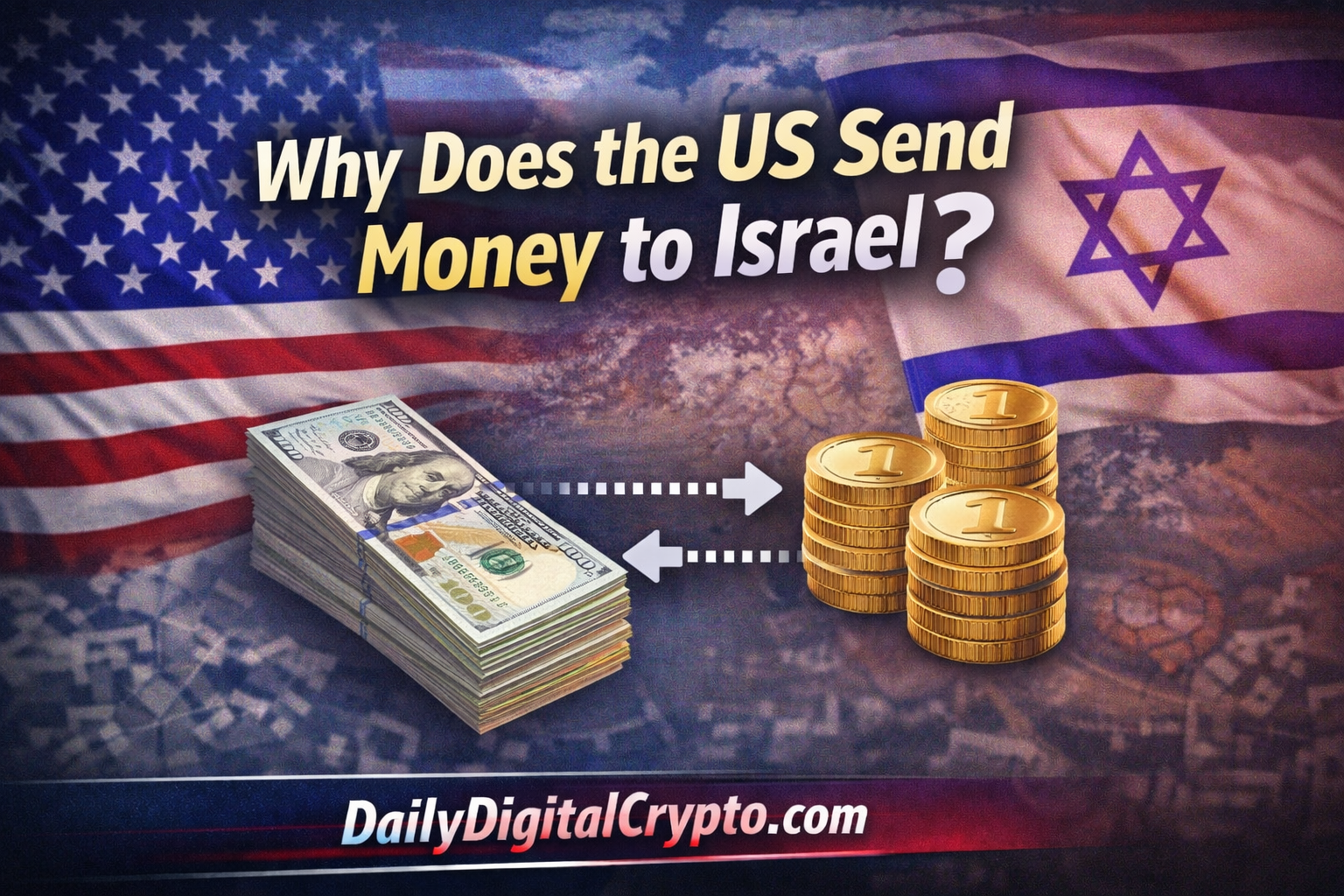
Every year, billions of American taxpayer dollars flow to one country more than any other on Earth.
That country is Israel.
It’s a policy that has survived for more than seven decades, outlasting dozens of administrations, shifting global politics, and growing public debate. And in 2026, the conversation is more intense and more interesting than ever before. So why exactly does the US send money to Israel? Is it about security? History? Politics? Mutual benefit?
Also Read: Transfer Money from US to UK in 2026
Table of Contents
A Relationship Built Over 75+ Years
The United States recognized Israel as a state in 1948, literally within minutes of its declaration of independence. That moment set the tone for one of the most durable alliances in modern history. In the early decades, US aid to Israel was mostly economic, helping a young, resource-poor nation build infrastructure and stabilize its economy. Military assistance began in earnest in 1959 and gradually became the dominant form of support. By the mid-1970s, military aid had overtaken economic aid entirely, and it has never looked back.
Today, Israel is the largest cumulative recipient of US foreign assistance since World War II, having received over $174 billion in non-inflation-adjusted dollars in bilateral assistance and missile defense funding, according to Congressional Research Service data.
How Much Does the US Actually Send Israel?
Here’s a clear snapshot of the current financial commitment:
| Aid Category | Annual Amount |
| Foreign Military Financing (FMF) | $3.3 billion |
| Missile Defense Cooperation | $500 million |
| Total Annual Baseline Aid | $3.8 billion |
This $3.8 billion per year is locked in by a 10-year Memorandum of Understanding (MOU) signed in 2016 by the Obama administration, covering fiscal years 2019 through 2028.
But that’s just the baseline.
Since the Hamas attacks of October 7, 2023, triggered Israel’s war in Gaza, Congress has approved far more. As of early 2026, the US has provided at least $16.3 billion in additional direct military aid through emergency and supplemental legislation on top of the annual MOU commitments.
And in January 2026, the US House of Representatives passed the National Security, Department of State, and Related Programs Appropriations Act (NSRP) for 2026, which includes another $3.3 billion in foreign military financing for Israel, passing with a bipartisan vote of 341-79.
Also Read: Congress Is Redrawing the Rules of Money Transmission in America
The 5 Core Reasons the US Sends Money to Israel
Strategic Partnership in a Volatile Region
The Middle East is one of the most strategically important and volatile regions on the planet. It sits at the crossroads of global energy supply, major shipping lanes, and the ongoing struggle against terrorism and Iranian expansionism. Israel serves as America’s most reliable foothold in that region.
When the US needs intelligence on Hezbollah, Hamas, or Iran’s nuclear program, Israel is often the most important source. The two countries share military technology, conduct joint exercises, and coordinate on regional threats in ways no other Middle Eastern ally can match. This is not charity. It’s a strategic investment.
Counterbalancing Iran
Iran is the elephant in the room.
Since the 1979 revolution, Iran has positioned itself as the chief adversary of both Israel and US interests in the region. It funds Hamas in Gaza, Hezbollah in Lebanon, Houthi rebels in Yemen, and various proxy militias across Iraq and Syria. The US uses military aid to Israel as a counterweight to Iranian influence.
When Iran launched direct ballistic missile attacks on Israel in April and October 2024 and again in June 2025, US forces actively helped defend Israeli territory, intercepting missiles using THAAD and Patriot systems deployed at American expense. Supporting Israel’s missile defense capability is, from Washington’s perspective, a cost-effective way to contain Iran without committing US troops to ground combat.
The Defense Industry Benefit
Here’s something that often gets overlooked: most of the money never actually leaves the United States.
By law, Israel must spend over 90% of its Foreign Military Financing on American-made weapons and equipment, with that figure soon rising to 100%.
This means billions of dollars flow directly into US defense companies like Lockheed Martin, Boeing, and Raytheon each year. American workers in dozens of states build the F-35 fighter jets, KC-46A tanker aircraft, CH-53K helicopters, and missile systems that Israel purchases with US aid dollars.
Senator Lindsey Graham put it bluntly in early 2026 when discussing the future of aid: if Israel ends its reliance on US aid, those billions should be “plowed back into the US military.”
For US defense contractors and their congressional allies, Israeli military aid is, in a real sense, a domestic jobs program.
Shared Intelligence and Technology Development
Beyond weapons purchases, the US-Israel relationship has produced some of the most important military technology innovations of the past few decades.
The Iron Dome, David’s Sling, and Arrow missile defense systems,s jointly developed and funded by both countries, have become models for modern anti-missile warfare.
The 2026 National Defense Authorization Act includes $35 million specifically for US-Israel collaboration on artificial intelligence and cybersecurity, and increases funding to counter drone threats by up to $70 million.
In the emerging battlefield domains of cyber and AI, Israel is one of the few countries whose technology is genuinely ahead of, or on par with, the US itself. The aid relationship funds a two-way knowledge exchange.
Historical, Cultural, and Political Ties
It would be intellectually dishonest to ignore the political dimension.
AIPAC (the American Israel Public Affairs Committee) is one of the most effective lobbying organizations in Washington. Evangelical Christian communities, a major Republican voting bloc,c hold deep religious convictions about supporting Israel. Jewish-American communities, while increasingly divided on specific policies, have historically maintained strong ties to Israel’s security.
These domestic political forces have helped sustain bipartisan congressional support for Israel aid for generations, making it one of the most durable foreign policy commitments in American history.
The Big 2026 Twist: Netanyahu Wants to End US Aid
In January 2026, Israeli Prime Minister Benjamin Netanyahu did something almost no one expected.
In a high-profile interview with The Economist, he proposed gradually phasing out US military aid to Israel over the next decade.
“I want to taper off military aid within the next 10 years,” Netanyahu said. “We’ve come of age.”
His reasoning? Israel’s economy, already strong and technology-driven, is on track to reach $1 trillion within a decade. Its domestic defense industry has grown powerful enough to sustain the military largely on its own. And being dependent on US aid, Netanyahu suggested, has political costs that can constrain Israel’s military decision-making.
The proposal sent shockwaves through Washington.
Senator Lindsey Graham responded by suggesting the US shouldn’t even wait 10 years it should “dramatically expedite” the termination of military aid and redirect those billions back into the US military.
The current MOU expires in 2028, and negotiations over a replacement agreement will be one of the defining foreign policy storylines of the next two years.
The Growing Debate: Critics vs. Supporters
The US-Israel aid relationship has never faced more scrutiny than it does today.
Those who support continued aid argue:
- It keeps a critical ally armed and capable in one of the world’s most dangerous neighborhoods
- It generates billions in US defense industry revenue and jobs
- It funds joint technology development that benefits both countries
- It sends a clear signal to Iran and other adversaries that the US commitment to Israel is ironclad
- It has been essential to the survival of a democratic US ally surrounded by hostile actors
Those who question or oppose the aid argue:
- Israel is now a wealthy, technologically advanced nation that doesn’t need a subsidy
- A recent Pew Research Center survey found that the share of Americans with a favorable opinion of Israel has fallen by 11 percentage points over the past three years, now standing at 56%.
- Around 42% of Americans now believe aid should be reduced or ended entirely, according to an Economist/YouGov poll.
- Critics argue that the Leahy Law, which prohibits aid to military units that commit gross human rights violations, has not been consistently applied to Israel
- Some argue that aid removes the incentive for diplomatic compromise on the Palestinian issue.
It’s a debate that crosses party lines and reflects deeper questions about America’s role in the world.
The figures that put everything into perspective.
To understand the scale of this commitment, consider a few comparisons:
- The $3.8 billion annual baseline represents less than 1% of the US federal budget for foreign military assistance
- Israel’s proposed 2026 defense budget is approximately $35 billio,n meaning US aid covers roughly 10% of its total defense spending.ng
- Since October 7, 2023, the US has provided at least $34 billion in total defense-related support to Israel, including direct spending to defend Israeli territory from Iranian attacks, according to a Brown University report.
The relationship is massive in absolute terms,s but the US has consistently chosen to view it as affordable given the strategic returns.
What Happens After 2028?
The current MOU expires in 2028, and the next few years will be critical.
Three possible paths are emerging:
Status Quo Extended: A new MOU is negotiated that maintains similar funding levels, perhaps with adjustments for inflation or new security priorities like cyber and AI.
Transition to Partnership Following Netanyahu’s proposal, a new framework replaces direct military aid with joint R&D investment funds, technology co-development, and co-production agreements. Israel gets weapons without the political baggage; the US gets technology partnerships.
Accelerated Phaseout With bipartisan appetite growing for fiscal discipline, Congress accelerates the end of traditional FMF aid to Israel while maintaining missile defense cooperation.
All three paths are now genuinely on the table. The coming negotiations will be historic.
Quick Summary Table
| Factor | Details |
| Annual Aid Amount | $3.8 billion (baseline) |
| Total Aid Since Founding | $352+ billion (inflation-adjusted) |
| Post-Oct. 7 Emergency Aid | $16.3+ billion additional |
| Current MOU Expiry | 2028 |
| US Defense Industry Benefit | 90%+ of FMF spent on US weapons |
| Netanyahu’s Proposal | Taper off aid over 10 years |
FAQs: Why Does the US Send Money to Israel?
Q: How much does the US send Israel every year?
The baseline commitment is $3.8 billion annually, $3.3 billion in Foreign Military Financing, and $500 million for missile defense, locked in by a 2016 Memorandum of Understanding running through 2028. Since the Gaza war began in 2023, additional emergency funding has pushed actual totals much higher.
Q: Does Israel have to use the money to buy American weapons?
Yes, by law, Israel must spend over 90% of its Foreign Military Financing on US-made weapons and defense products, with that figure set to reach 100%. This means most of the money cycles back into the American defense industry.
Q: Why does the US support Israel strategically?
The US views Israel as its most reliable and capable ally in the Middle East a partner for intelligence sharing, joint military exercises, technology development, and counterbalancing Iranian influence in the region.
Q: Has public support for Israel aid changed?
Yes, significantly. A Pew Research Center poll found that favorable views of Israel among Americans dropped 11 percentage points over three years to 56%. Around 42% of Americans now say aid should be reduced or ended, according to recent polling.
Q: Is Israel trying to end US military aid?
In a surprising January 2026 move, Israeli Prime Minister Netanyahu said he wants to gradually phase out US military aid over the next 10 years, citing Israel’s growing economic strength and defense capability. Negotiations over a post-2028 framework are expected to begin soon.
Q: What US laws govern military aid to Israel?
Key laws include the Foreign Assistance Act, the Arms Export Control Act, and the Leahy Law, which prohibits aid to foreign military units that commit gross human rights violations. Critics have arguedthat the Leahy Law has not been applied consistently in Israel’s case.
Q: Does US aid to Israel benefit American taxpayers in any way?
Supporters argue yes because Israel uses the funds to buy American weapons, the aid effectively subsidizes the US defense industry, supports American manufacturing jobs, and funds joint technology development that benefits US national security. Critics counter that those billions could be better spent at home.