 Bitcoin
  Ethereum
  Tether
  BNB
BNB  XRP
XRP  USDC
USDC  Solana
  TRON
TRON  Lido Staked Ether
  Figure Heloc
  Dogecoin
  USDS
USDS  WhiteBIT Coin
  Bitcoin Cash
  LEO Token
  Wrapped stETH
  Cardano
  Hyperliquid
  Wrapped Bitcoin
  Chainlink
  Binance Bridged USDT (BNB Smart Chain)
  Monero
  Wrapped Beacon ETH
  Ethena USDe
  Canton
  Stellar
  Wrapped eETH
  USD1
USD1  Dai
Dai  sUSDS
sUSDS  Zcash
Zcash  Litecoin
  MemeCore
  Coinbase Wrapped BTC
  Rain
Rain  PayPal USD
  Avalanche
  WETH
WETH  Hedera
  Shiba Inu
  Sui
Sui  USDT0
USDT0  Toncoin
  Cronos
  Bittensor
  World Liberty Financial
  Circle USYC
  Tether Gold
  PAX Gold
  Ethena Staked USDe
 US Court Dismisses Uniswap Class Action: A DeFi Game-Changer
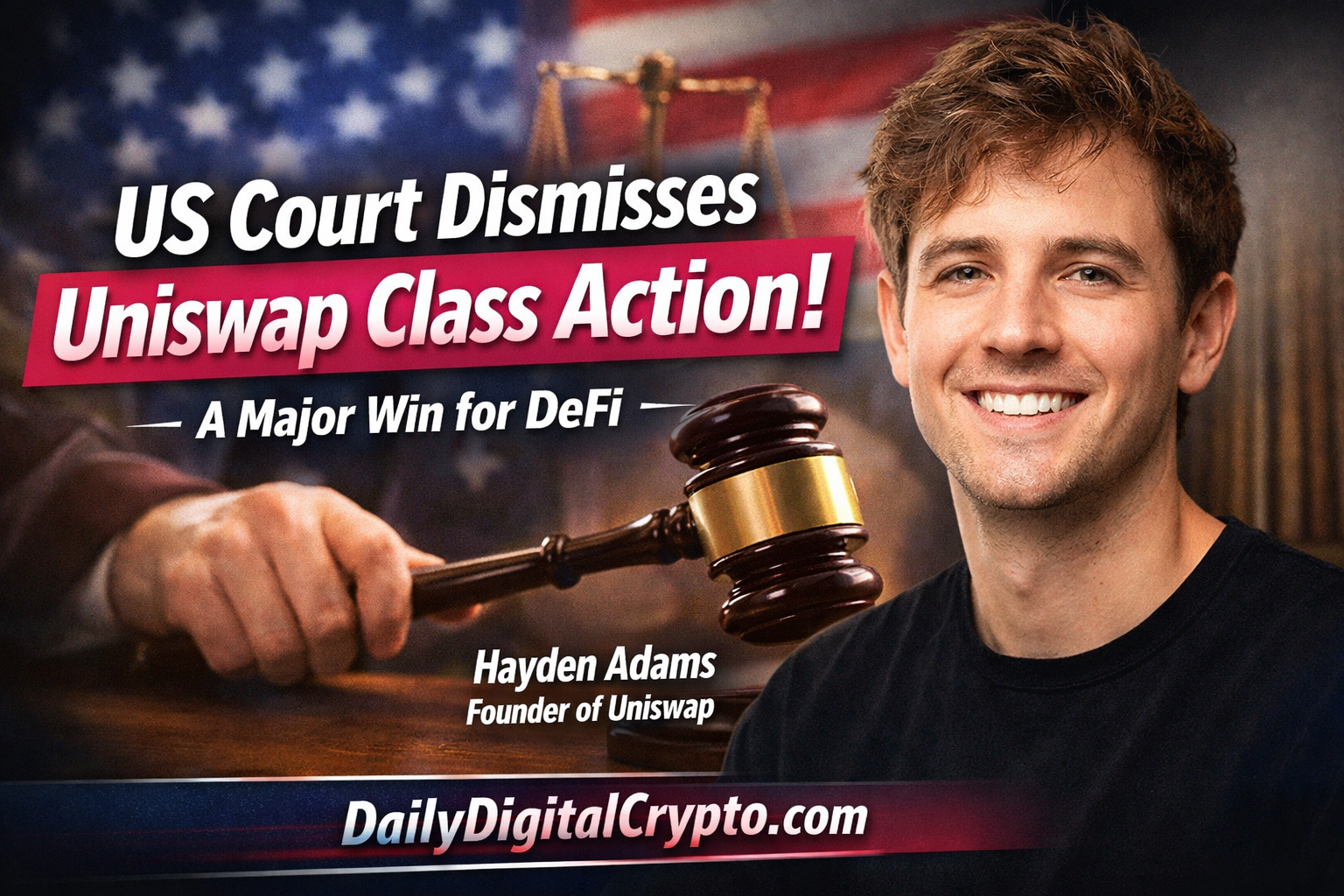
US Court Dismisses Uniswap Class Action: What It Means for DeFi. On March 3, 2026, a four-year legal battle finally ended, and the verdict sent shockwaves across the crypto world. A federal judge in New York dismissed all remaining claims in the class action lawsuit against Uniswap Labs, founder Hayden Adams, and several high-profile venture capital backers. The case is now officially closed. This goes beyond just a victory for Uniswap. It’s potentially the most significant legal ruling in the history of decentralized finance.
Table of Contents
What Was the Uniswap Class Action Lawsuit About?
The lawsuit, formally known as Risley v. Universal Navigation Inc., was filed in April 2022 by a group of investors led by Nessa Risley. The plaintiffs claimed they lost money on so-called “rug pull” tokens and pump-and-dump schemes that were traded through Uniswap’s protocol. Because the token issuers were unknown and untraceable, the investors turned their legal crosshairs toward the most identifiable parties they could find.
Those defendants included:
- Uniswap Labs — the Brooklyn-based company operating the protocol
- Hayden Adams — Uniswap’s founder and CEO
- Paradigm — a leading crypto venture firm
- Andreessen Horowitz (a16z) — one of Silicon Valley’s most prominent VCs
- Union Square Ventures — another major backer
The core argument? By providing the infrastructure for token trading, Uniswap and its backers effectively “facilitated” fraud, making them liable for investor losses.
How Did the Case Unfold Over Four Years?
The lawsuit moved through multiple phases, each one building toward Monday’s final dismissal.
August 2023: Federal Claims Dismissed
Judge Katherine Polk Failla of the U.S. District Court for the Southern District of New York dismissed the plaintiffs’ federal securities claims in 2023, famously stating it “defies logic” to hold a smart contract developer responsible for how third parties use the platform. The judge’s blunt language resonated across the crypto community. But the case wasn’t over yet.
Also Read: How U.S. Crypto Sanctions Laws Work?
February 2025: Second Circuit Weighs In
The Second Circuit Court of Appeals affirmed the dismissal of federal claims. However, it sent the remaining state-level consumer protection claims back to the district court for a fresh review. The plaintiffs weren’t giving up easily.
May 2025: A Second Amended Complaint
The plaintiffs filed a second amended complaint, this time shifting focus entirely to state law. They brought six new claims:
| Claim | Status |
| Aiding and abetting fraud | Dismissed |
| Aiding and abetting negligent misrepresentation | Dismissed |
| NY consumer protection violations | Dismissed |
| North Carolina consumer protection violations | Dismissed |
| Idaho consumer protection violations | Dismissed |
| Unjust enrichment | Dismissed |
All six failed.
March 3, 2026: Final Dismissal With Prejudice
Judge Failla dismissed the second amended complaint with prejudice, meaning the plaintiffs cannot refile the same case. The Clerk of Court was directed to close the case entirely.
Why Did the Court Dismiss the Case?
The Decentralization Defense
At the heart of the ruling lies a principle that DeFi advocates have argued for years: a decentralized, permissionless protocol is fundamentally different from a centralized financial intermediary. Judge Failla recognized that Uniswap operates via autonomous smart contracts. No one at Uniswap Labs approves token listings, controls trades, or selects which assets appear on the platform. Anyone can create a pool. Anyone can trade. Because of this architecture, the court found that developers and investors cannot simply be held responsible for what third parties do on the infrastructure they built.
The “Bank Analogy” That Says It All
Judge Failla offered a compelling analogy to explain her reasoning.
She compared Uniswap to a bank that unknowingly processes a money launderer’s transactions or to WhatsApp, which a drug dealer might use to coordinate a sale. In both cases, the infrastructure provider offers “ordinary services that anyone could use for lawful purposes.” Providing a tool that bad actors misuse is not the same as assisting in the fraud itself.
The Knowledge Problem
On the fraud aiding-and-abetting claim specifically, the plaintiffs could not show that Uniswap Labs had actual knowledge of the specific scams while they were occurring.
Customer complaint emails were received only after the transactions had already been completed. Social media warnings about rug pulls targeted other investors, not Uniswap’s team. A March 2022 report about widespread rug pulls landed too late in the class period and never specifically mentioned the 38 tokens named in the complaint.
The Unjust Enrichment Collapse
The unjust enrichment claim fell apart on a straightforward fact: Uniswap Labs never activated its fee switch during the relevant class period. The interface fee only launched in October 2023, well outside the window being litigated. Since Uniswap never financially benefited from the disputed trades, there was nothing to “unjustly” recover.
Who Were the Key Players in This Ruling?
Judge Katherine Polk Failla The Southern District of New York judge who presided over the entire case. Her language throughout has been notably direct and precedent-aware.
Hayden Adams, the founder of Uniswap, marked the ruling on X (formerly Twitter), stating that if someone develops open-source smart contract code and bad actors misuse it, the responsibility lies with those scammers, not the developer. are liable, not the open source devs. Good, sensible outcome.”
Brian Nistler, Uniswap’s head of policy and associate general counsel, confirmed the ruling publicly.
Irina Heaver UAE-based crypto lawyer, told CoinDesk the dismissal shows courts are engaging more seriously with the realities of decentralization.
What Does “Dismissed With Prejudice” Actually Mean?
This matters more than people realize.
A dismissal without prejudice allows the losing party to refile with better arguments or new evidence. Courts sometimes grant these when a case has procedural flaws rather than fundamental legal problems.
A dismissal with prejudice is final. The plaintiffs are permanently barred from bringing the same claims again. There is no second chance, no amended complaint #3, no next shot.
For Uniswap, this is the cleanest possible outcome.
Market Reaction: UNI Token Jumps
The market responded immediately and decisively.
According to CoinGecko data, the UNI token climbed roughly 10% following the ruling, briefly reaching $3.92 before settling back around $3.88. While that remains modest in absolute terms, the directional signal from investors was clear: this ruling is good for Uniswap.
Why This Ruling Matters for the Entire DeFi Industry
This case was never really just about Uniswap. It was a proxy battle for a much larger question:
Can open-source protocol developers be held legally liable for how others use their code?
The answer, after four years of litigation across multiple courts, is a resounding no at least under current law.
Implications for DeFi Developers
- Writing and deploying smart contracts does not make a developer responsible for third-party misuse.
- Providing permissionless infrastructure is legally distinct from operating a centralized broker.
- Courts are beginning to draw a clear line between protocol creators and the scammers who exploit them.
A Warning Shot to Congress
Judge Failla was explicit: if lawmakers want tighter regulation of decentralized protocols, they need to write new laws. Stretching 1930s-era securities statutes to cover autonomous smart contracts is not the court’s job. This implicitly puts pressure on Congress to craft DeFi-specific legislation rather than relying on courts to apply outdated frameworks.
The Tornado Cash Question
Legal experts are already asking whether this reasoning will carry into criminal cases. Dubai-based crypto attorney Irina Heaver specifically flagged the Tornado Cash situation as the next frontier. If a permissionless protocol cannot be held civilly liable for what third parties do with it, does the same logic apply in criminal proceedings? That question is far from settled.
Also Read: After the Trump Bump The Forces Steering Crypto in 2026
Recent Uniswap Legal Wins: A Pattern Forming
It’s worth noting that this dismissal isn’t Uniswap’s only recent courtroom victory. Just last month, a judge dismissed a patent infringement lawsuit filed against Uniswap by Bancor, a competing decentralized exchange. That ruling, combined with the Risley dismissal, signals a legal environment that is increasingly receptive to the argument that DeFi protocols operate on fundamentally different principles than traditional financial intermediaries.
Voices From the DeFi Community
The ruling drew celebratory responses from across the space.
Hayden Adams called it “a good, sensible outcome” and a precedent-setting victory for open-source developers.
Aave’s founder described it as “a great win for DeFi,” signaling that the broader ecosystem sees the implications as industry-wide.
Legal commentator N0th1n3 posted on X that the logic running through this ruling hasn’t changed since the first dismissal in 2023; the plaintiffs simply could not hold Uniswap liable for the “misconduct of unidentified third-party issuers.”
The Limits of This Victory
Let’s be balanced here. This ruling is significant, but it doesn’t mean DeFi is suddenly litigation-proof.
A few important caveats:
- The ruling does not insulate the crypto industry from broader regulatory oversight
- Token classification, consumer protection enforcement, and compliance standards are still evolving
- Centralized crypto entities remain far more exposed to traditional securities law
- Regulatory agencies like the SEC and CFTC continue to pursue enforcement actions independently of private lawsuits
The DeFi legal landscape is clearer today than it was yesterday but it isn’t blank.
Key Takeaways at a Glance
| What Happened | Detail |
| Case name | Risley v. Universal Navigation Inc. |
| Filed | April 2022 |
| Final ruling | March 3, 2026 |
| Presiding judge | Katherine Polk Failla, SDNY |
| Outcome | Dismissed with prejudice |
| Defendants | Uniswap Labs, Hayden Adams, Paradigm, a16z, USV |
| Claims dismissed | 6 state-law claims, including fraud aiding, consumer protection, and unjust enrichment |
| UNI price reaction | +10% briefly following the ruling |
(FAQs) US Court Dismisses Uniswap Class Action
Q: Why did the US court dismiss the Uniswap class action?
The court found that Uniswap’s decentralized, permissionless protocol is fundamentally different from a centralized exchange. Since smart contracts execute automatically and Uniswap Labs had no actual knowledge of specific scams during the class period, the plaintiffs could not establish the legal requirements for liability.
Q: What does “dismissed with prejudice” mean for the Uniswap case?
It means the case is permanently closed. The plaintiffs cannot refile the same lawsuit. Unlike a dismissal without prejudice, there is no opportunity to come back with a revised complaint on the same grounds.
Q: Who filed the lawsuit against Uniswap?
The class action was originally filed in April 2022 by a group of investors led by Nessa Risley. They claimed losses from alleged rug pull tokens and pump-and-dump schemes traded through Uniswap’s protocol.
Q: Are Uniswap’s venture capital backers also off the hook?
Yes. The ruling covers all named defendants, including Paradigm, Andreessen Horowitz (a16z), and Union Square Ventures. The court found that providing backing for a decentralized protocol does not create liability for how third parties use it.
Q: Does this ruling mean DeFi protocols are immune to lawsuits?
Not exactly. The ruling applies to this specific set of claims under current law. It doesn’t prevent future lawsuits under different legal theories, nor does it shield DeFi from regulatory enforcement actions by bodies like the SEC or CFTC.
Q: How did UNI token respond to the ruling?
According to CoinGecko data, UNI jumped roughly 10% immediately following the ruling, briefly hitting $3.92, before settling back around $3.88.
Q: What’s the broader impact of this ruling on DeFi development?
The ruling establishes a meaningful precedent: writing open-source smart contract code does not automatically make a developer liable if that code is later misused by bad actors. This gives developers greater legal clarity, though the regulatory landscape as a whole continues to evolve.
Q: Could this ruling affect the Tornado Cash criminal case?
Legal experts are watching closely. If civil liability cannot be assigned to a permissionless protocol’s developers, some argue the same logic should inform criminal proceedings. But criminal law operates under different standards, and that question remains unsettled.