
 Bitcoin
  Ethereum
  Tether
  BNB
BNB  XRP
XRP  USDC
USDC  Solana
  TRON
TRON  Lido Staked Ether
  Figure Heloc
  Dogecoin
  USDS
USDS  WhiteBIT Coin
  Bitcoin Cash
  LEO Token
  Wrapped stETH
  Cardano
  Hyperliquid
  Wrapped Bitcoin
  Chainlink
  Binance Bridged USDT (BNB Smart Chain)
  Monero
  Wrapped Beacon ETH
  Ethena USDe
  Canton
  Stellar
  Wrapped eETH
  USD1
USD1  Dai
Dai  sUSDS
sUSDS  Zcash
Zcash  Litecoin
  MemeCore
  Coinbase Wrapped BTC
  Rain
Rain  PayPal USD
  Avalanche
  WETH
WETH  Hedera
  Shiba Inu
  Sui
Sui  USDT0
USDT0  Toncoin
  Cronos
  Bittensor
  World Liberty Financial
  Circle USYC
  Tether Gold
  PAX Gold
  Ethena Staked USDe
 After the Trump Bump The Forces Steering Crypto in 2026
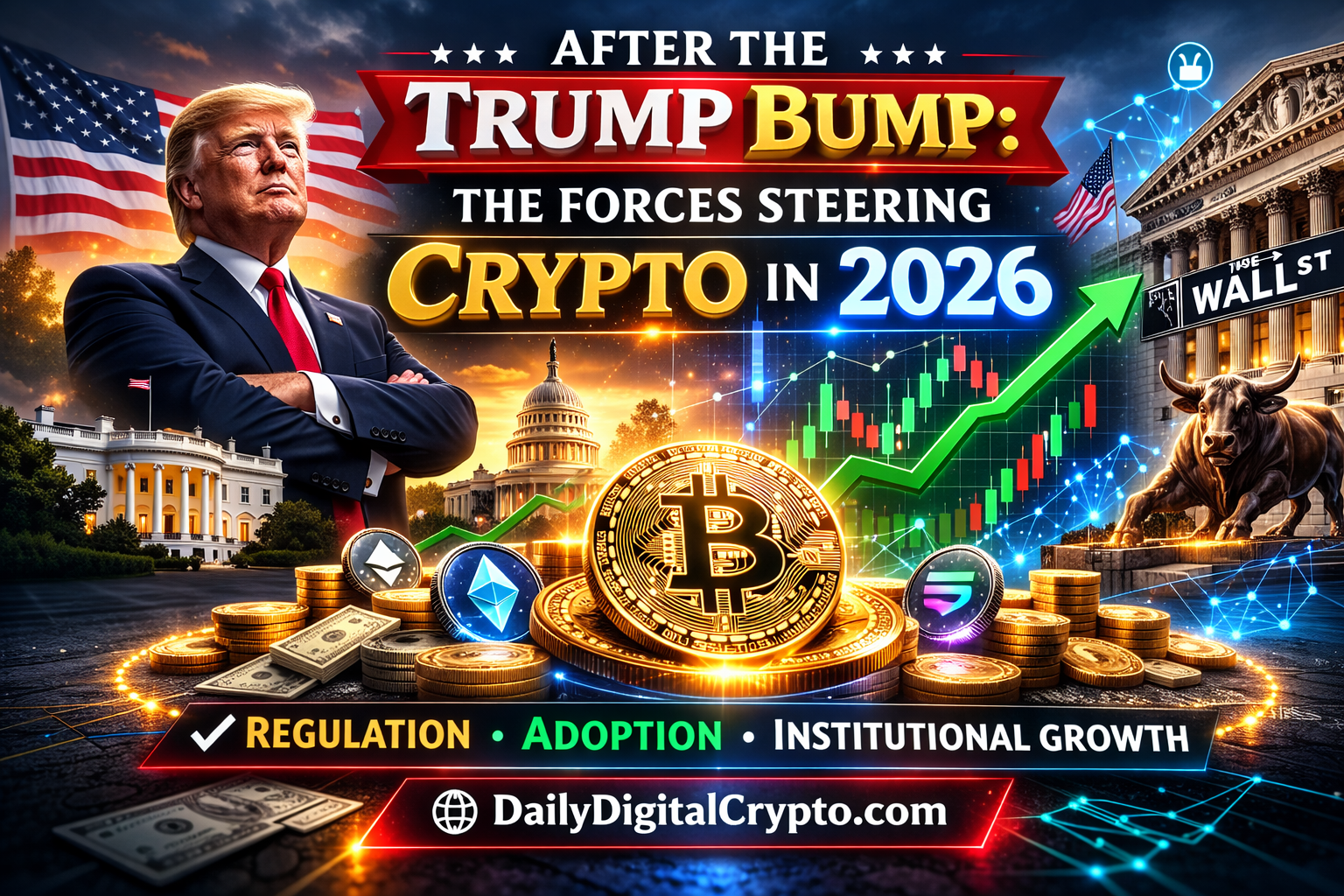
The Trump Bump that’s exactly what they called it, and honestly, no phrase captured crypto’s wild ride after the 2024 U.S. election better. Bitcoin shattered records. Altcoins exploded. Meme coins briefly made headlines again. The so-called “Trump Bump” sent digital assets into a frenzy, fueled by optimism around a more crypto-friendly White House and promises of lighter regulation. After the Trump Bump The Forces Steering Crypto in 2026 explores regulation shifts, institutional capital flows, and the trends shaping digital assets.
Also Read: How U.S. Crypto Sanctions Laws Work
The hype has settled. The dust is clearing. And what’s emerging is something far more interesting than a simple bull run a reshaping of crypto’s foundations by forces that go way beyond politics. So what’s actually steering the market now?
Table of Contents
The Trump Bump: A Quick Recap
After Donald Trump won the 2024 presidential election, Bitcoin surged past $100,000 for the first time in history, hitting an all-time high of roughly $108,000 by December 2024. That’s not just a number that’s a signal. Markets were pricing in regulatory relief, pro-crypto cabinet picks, and a government that wouldn’t treat digital assets like financial villains.
Also Read: Bitcoin Market News Today 2026
The administration did deliver on some fronts. The SEC’s aggressive stance under Gary Gensler gave way to a more collaborative posture. The U.S. Strategic Bitcoin Reserve a concept that seemed outlandish two years ago began moving from theory to policy discussion.
But after the initial euphoria, reality started knocking.
Regulation Finally Getting Its Act Together
The Clarity Markets Have Been Begging For
For years, the crypto industry operated in a legal gray zone. Was Ethereum a security? Was staking taxable at receipt or sale? Nobody agreed. In 2025–2026, that started to change meaningfully.
Congress passed landmark digital asset legislation that finally drew clearer lines between commodities and securities. While imperfect, the law gave exchanges, DeFi protocols, and institutional players a rulebook they could actually follow. The result? Renewed institutional confidence.
What this means for the market:
- Major banks like JPMorgan and Goldman Sachs expanded their crypto custody and trading desks
- Pension funds and endowments long frozen out by compliance concerns began cautious allocations
- Stablecoin issuers faced stricter reserve requirements, but that actually boosted consumer trust
The irony? More regulation made crypto more attractive to the traditional money that had been sitting on the sidelines.
Institutional Capital The Grown-Ups Are Here
BlackRock, Fidelity, and the ETF Effect
The approval of spot Bitcoin ETFs in early 2024 was a turning point that didn’t fully play out until 2025 and 2026.
In just 18 months after launch, Bitcoin ETFs accumulated over $100 billion in assets under management. That’s not retail traders buying on Robinhood that’s pension managers, family offices, and sovereign wealth funds moving serious capital into the space.
| Institutional Player | 2026 Crypto Activity | Estimated Exposure |
| BlackRock | Spot BTC & ETH ETFs | $50B+ AUM |
| Fidelity | Custody + ETF products | $30B+ AUM |
| Goldman Sachs | Trading desk + derivatives | Undisclosed |
| JPMorgan | Tokenized assets + custody | Multi-billion |
This isn’t your 2017 crypto crowd. These players bring discipline, long-term horizons, and crucially they don’t panic-sell during a news cycle.
Macro Conditions The Fed’s Shadow Looms Large
Interest Rates, Inflation, and the Risk Appetite Game
Crypto doesn’t exist in a vacuum. It’s deeply sensitive to macroeconomic conditions particularly interest rates.
As the Federal Reserve began cutting rates in late 2024 and into 2025, risk assets breathed a sigh of relief. Lower rates mean cheaper capital, and cheaper capital finds its way into higher-risk, higher-reward assets including crypto.
But 2026 brought a fresh wrinkle: sticky inflation in some sectors kept the Fed cautious. That’s created a push-pull dynamic where crypto rallies on rate-cut hopes and stumbles when inflation data disappoints.
Key macro drivers to watch:
- Federal Reserve rate decisions (every FOMC meeting now moves markets)
- U.S. dollar strength — a weaker dollar historically boosts Bitcoin
- Global liquidity cycles — China’s stimulus policies have outsized effects
- Treasury yields — as yields fall, Bitcoin becomes relatively more attractive
Technology Ethereum, Layer 2s, and the Quiet Revolution
The Infrastructure Upgrade Nobody’s Talking About Enough
While price charts dominate headlines, something quieter and more powerful is happening under the hood. Ethereum’s ecosystem has matured dramatically. Layer 2 networks like Arbitrum, Base, and Optimism process millions of transactions daily at near-zero fees. This isn’t just a technical upgrade it’s what makes real-world applications viable.
DeFi Is Growing Up
Decentralized finance protocols now handle hundreds of billions in total value locked (TVL). More importantly, they’re being used for things that matter: cross-border payments, trade finance, tokenized real estate, and even government bond settlements in some jurisdictions.
Bitcoin’s Expanding Role
Bitcoin itself is evolving. The Ordinals and Runes protocols brought NFTs and token issuance to the Bitcoin blockchain, creating a vibrant new ecosystem that very few predicted just two years ago.
Also Read: Fed Payment Access Sparks Crypto Banking Turf War
Geopolitics The Dollar, De-dollarization, and Crypto as a Hedge
Here’s where things get genuinely fascinating. Several emerging market countries facing dollar shortages, sanctions, or currency instability have turned to stablecoins and Bitcoin as practical financial tools, not speculative ones. Argentina’s peso crisis drove record peer-to-peer Bitcoin trading volumes. Nigeria’s naira devaluation made USDT (Tether) a de facto savings account for millions. Meanwhile, BRICS nations are actively exploring blockchain-based trade settlement systems that bypass the dollar entirely.
This isn’t a fringe trend. It’s a structural shift that adds a new, more durable source of demand for crypto assets completely divorced from Trump, the Fed, or Wall Street sentiment.
What Happens Next? Honest Projections for Late 2026
| Scenario | Likelihood | Bitcoin Price Range | Key Catalyst |
| Continued Bull Run | Moderate | $150,000–$200,000 | ETF inflows + rate cuts |
| Sideways Consolidation | High | $80,000–$120,000 | Regulatory uncertainty |
| Sharp Correction | Lower | $50,000–$70,000 | Macro shock or hack event |
| New ATH Cycle | Possible | $200,000+ | Sovereign adoption surge |
Nobody has a crystal ball. But the structural forces described above regulation, institutional capital, macro shifts, technology, and geopolitics suggest this is no longer a market that moves purely on speculation and tweets.
Frequently Asked Questions
What exactly was the “Trump Bump” in crypto?
The Trump Bump refers to the sharp rally in cryptocurrency prices that followed Donald Trump’s 2024 election victory. Bitcoin surged to over $100,000 as markets anticipated more crypto-friendly regulation, a softer SEC, and broader policy support for digital assets.
Is crypto still a good investment in 2026?
That depends entirely on your risk tolerance, time horizon, and financial situation. Crypto remains a high-volatility asset class. The improving regulatory environment and institutional adoption have reduced some risks, but significant volatility remains. Always consult a financial advisor before investing.
How does the Federal Reserve affect crypto prices?
When the Fed cuts interest rates, investors often move toward riskier assets seeking better returns crypto often benefits. When rates rise or inflation stays high, money tends to flow to safer investments, putting pressure on crypto prices.
What are Layer 2 networks and why do they matter?
Layer 2 networks are blockchain systems built on top of a base layer (like Ethereum) to process transactions faster and cheaper. They matter because they make crypto usable for everyday applications payments, gaming, finance without the high fees and slow speeds of the main chain.
Is Bitcoin being used as real money in other countries?
Yes, increasingly so. In countries with unstable currencies or limited banking access like Argentina, Nigeria, and parts of Southeast Asia Bitcoin and dollar-pegged stablecoins are being used for savings, payments, and remittances in meaningful, practical ways.