
Senate Democrats Probe Binance Iran Sanctions $1.7B
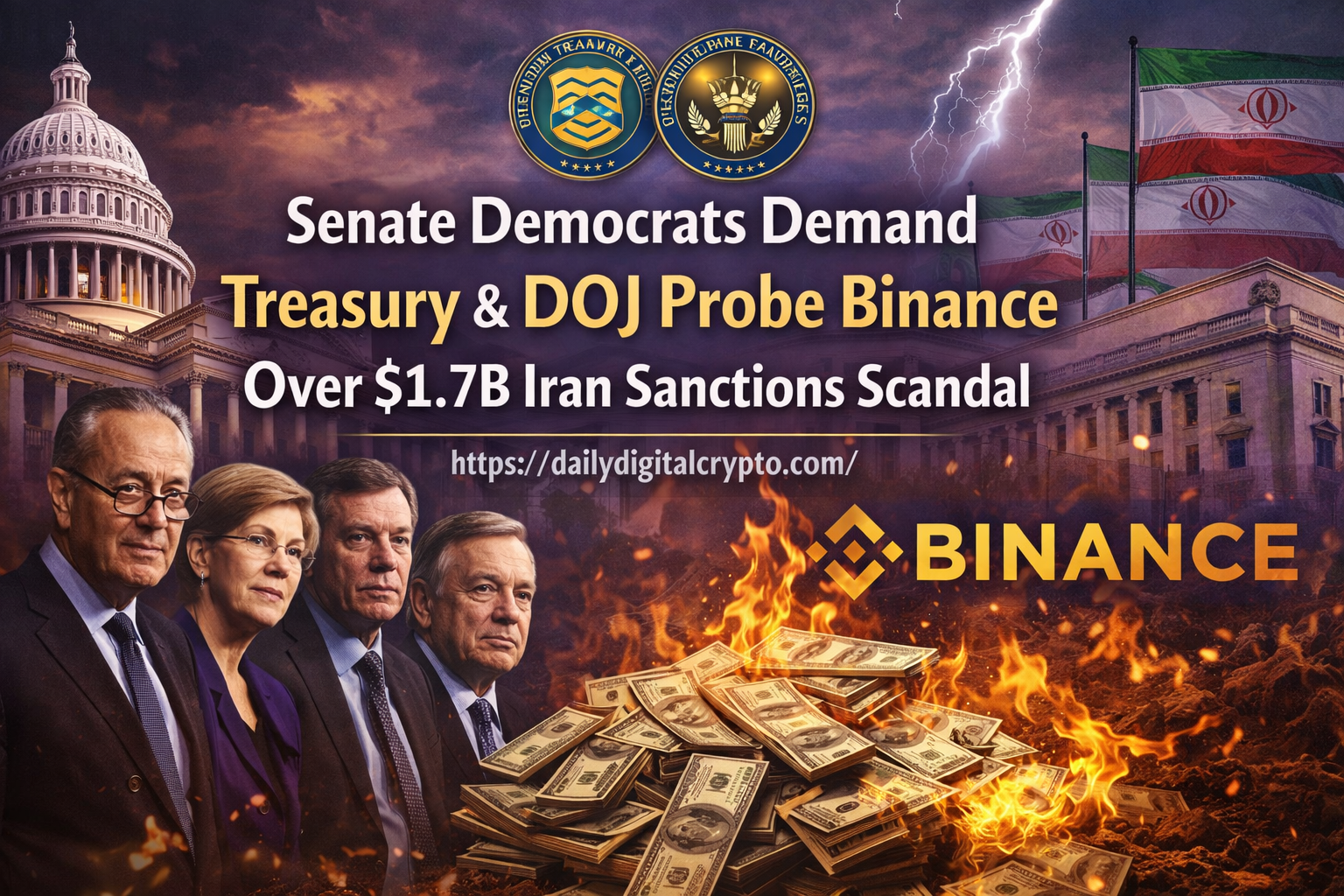
Senate Democrats are pushing the DOJ & Treasury to investigate Binance over alleged $1.7B in Iran sanctions-linked crypto transfers and compliance failures. The letter, sent on February 27, 2026, was addressed to Treasury Secretary Scott Bessent and Attorney General Pam Bondi. It marks one of the most serious Congressional challenges to Binance since its landmark 2023 federal settlement and this time, the political stakes are even higher given Binance’s newly reported ties to the Trump family’s crypto ventures.
Also Read: Hong Kong Expands Digital Asset Access New Laws & Tax Breaks
If the allegations hold up under scrutiny, the consequences for the global crypto market already navigating a fragile regulatory landscape could be significant. Here’s everything you need to know about the 2026 Binance-Iran probe and why it matters.
What Did the Senate Democrats Actually Allege?
The letter led by Sen. Mark Warner and co-signed by ranking member Sen. Elizabeth Warren along with nine other Democrats is not based on government investigation findings alone. It draws heavily from recent media reports that painted a damning picture of Binance’s internal compliance failures.
According to the senators, Binance’s own compliance personnel discovered last year that approximately $1.7 billion in digital assets had been channeled through the exchange to Iranian entities. Those entities include:
- The Iran-backed Houthis in Yemen
- The Islamic Revolutionary Guard Corps (IRGC)
- Other groups linked to Hamas, Hezbollah, and Palestinian Islamic Jihad
In one particularly striking allegation, a Binance vendor reportedly moved $1.2 billion in transactions connected to Iran-linked actors. Additionally, the lawmakers claim that more than 1,500 Binance accounts were accessed by Iranian users — a direct violation of U.S. sanctions.
Critical Allegation: The senators also raised concerns that Binance employees who flagged these transactions were subsequently dismissed a potential act of retaliation that would itself violate the terms of the company’s 2023 federal settlement.
Which Senators Signed the Letter?
The bipartisan pressure is notable. The letter was signed by 11 Democratic senators, many of whom sit on the Senate Banking, Housing, and Urban Affairs Committee and have been directly involved in negotiations over the Digital Asset Market Clarity Act.
| Senator | State | Committee Role |
| Mark Warner (Lead) | Virginia | Banking Committee Member |
| Elizabeth Warren (Ranking) | Massachusetts | Ranking Member, Banking Committee |
| Chris Van Hollen | Maryland | Banking Committee Member |
| Jack Reed | Rhode Island | Banking Committee Member |
| Catherine Cortez Masto | Nevada | Banking Committee Member |
| Tina Smith | Minnesota | Banking Committee Member |
| Raphael Warnock | Georgia | Banking Committee Member |
| Andy Kim | New Jersey | Banking Committee Member |
| Ruben Gallego | Arizona | Banking Committee Member |
| Lisa Blunt Rochester | Delaware | Banking Committee Member |
| Angela Alsobrooks | Maryland | Banking Committee Member |
Sen. Richard Blumenthal of Connecticut has also separately announced an independent inquiry, writing directly to Binance to demand records related to two Hong Kong entities allegedly used as conduits for Iranian fund flows.
Binance’s 2023 Settlement: A Brief Recap
To understand why this probe is so significant, it’s essential to revisit what happened in 2023. That year, Binance and its founder Changpeng “CZ” Zhao pleaded guilty to federal charges that included violations of the Bank Secrecy Act and U.S. sanctions laws.
The settlement resulted in billions of dollars in penalties and required Binance to implement robust compliance controls — including systems capable of identifying and blocking transactions involving sanctioned entities. The company also accepted ongoing compliance monitoring.
Why This Matters Now: The 2026 allegations suggest those reforms may have been poorly implemented — or even rolled back. The senators argue that allowing $1.7 billion to flow to sanctioned Iranian entities directly contradicts the company’s settlement commitments.
CZ served a four-month prison sentence following his guilty plea. He was subsequently pardoned by President Trump a fact the senators cited as a reason why any federal investigation must be “demonstrably impartial.”
The Trump Connection: Why This Probe Is Politically Explosive
The 2026 Binance investigation isn’t just about crypto compliance. It’s wrapped in a web of political entanglements that involve the sitting U.S. president.
The senators’ letter specifically points to Binance’s connection with World Liberty Financial, a cryptocurrency initiative reportedly supported by the Trump family. Specifically, Binance has been promoting USD1, a stablecoin issued by World Liberty Financial, by offering interest incentives to users who hold it. The exchange also reportedly assisted with the technical infrastructure behind the token and accepted a $2 billion investment linked to the project.
Furthermore, the letter points to President Trump’s pardon of CZ as a conflict of interest. The lawmakers wrote that these connections make it “imperative” that the probe be independent and free from political influence.
Senate Democrats’ letter to Sec. Bessent & AG Bondi, Feb. 27, 2026
Russia Sanctions Evasion: The Second Front
Iran is not the only sanctions concern raised by the senators. The letter also touches on Binance’s alleged facilitation of Russian sanctions evasion a separate but equally serious issue.
According to the senators, Binance recently launched crypto-linked payment cards in parts of the former Soviet Union. They warned that similar financial products have historically been used to circumvent restrictions on the Russian financial system.
The exchange has also partnered with Kyrgyzstan to launch a stablecoin and digital currency initiative raising further questions about exposure to sanctioned economies in the region. Kyrgyzstan has been identified in previous reports as a transit point for Russian capital flight following Western sanctions imposed after the 2022 invasion of Ukraine.
Also Read: How U.S. Crypto Sanctions Laws Work
What Is the Timeline and What Happens Next?
The senators set a firm deadline: they requested a formal response from both Treasury and the DOJ by March 13, 2026. They want the agencies to outline what steps they plan to take and whether they believe Binance remains in compliance with its 2023 settlement obligations.
📋 Key Dates:
🗓 2023: Binance pleads guilty; pays billions in penalties; CZ serves 4 months in prison.
🗓 Late 2024/2025: Internal Binance compliance staff allegedly identify $1.7B in Iran-linked transactions.
🗓 Early 2026: Media reports surface; Senator Blumenthal launches a separate inquiry.
🗓 Feb. 27, 2026: 11 Senate Democrats send formal letter to Treasury & DOJ.
🗓 March 13, 2026: Deadline for federal agencies to respond.
As of this writing, neither the Treasury Department nor the DOJ has announced a formal investigation in response to the senators’ request. Federal review would be required to substantiate or refute the specific claims made in the letter.
How Did Binance Respond?
Binance has been quick to push back. Richard Teng, the company’s co-CEO, publicly stated that some of the earlier media reports that sparked the senators’ concerns were “inaccurate” and “defamatory.”
A Binance spokesperson went further, asserting that:
- The company detected and reported suspicious transactions suggesting proactive compliance rather than concealment.
- Claims that the company retaliated against compliance staff are false.
- Binance remains committed to its regulatory obligations under the 2023 settlement agreements.
Binance did not, however, respond to the senators’ specific letter by the time of publication.
The Bigger Picture: Crypto Regulation at a Crossroads
This controversy is landing at a particularly fraught moment for U.S. crypto policy. The Digital Asset Market Clarity Act a sweeping piece of crypto regulation has been stalled in the Senate for months, partly due to disagreements over how to handle illicit finance risks in the industry.
Several of the senators who signed the Binance letter have been directly involved in those negotiations. Their willingness to press for a federal investigation sends a clear signal: they are not prepared to advance crypto-friendly legislation while outstanding compliance failures of this magnitude remain unaddressed.
JPMorgan analysts have noted that passage of the Clarity Act would bring significant institutional investment into the crypto market. But the Binance controversy could further delay that outcome or fundamentally reshape what the final bill looks like.
Comparing the 2023 Settlement vs. 2026 Allegations
| Aspect | 2023 Settlement | 2026 New Allegations |
| Violation Type | AML failures, KYC failures, sanctions violations | Ongoing Iran sanctions evasion, terrorism financing |
| Financial Amount | Billions in penalties paid | $1.7B in alleged illicit flows identified |
| Key Actor | CZ (founder, pled guilty) | Compliance staff allegedly dismissed after flagging issues |
| Government Response | Plea agreement, compliance monitoring installed | Under review — DOJ/Treasury response pending by March 13 |
| Political Context | Biden administration enforcement | Trump administration; Binance tied to Trump family ventures |
What This Means for Crypto Investors and the Industry
For retail crypto investors and institutional players alike, the probe raises several important considerations:
- Regulatory risk is real: Even the world’s largest exchange is not immune to compliance failures. Diversifying across regulated platforms remains a prudent strategy.
- Stablecoin scrutiny will intensify: The USD1 stablecoin connection to Trump’s World Liberty Financial adds a new dimension of political and regulatory risk to stablecoin holdings.
- AML standards are tightening: Exchanges globally will likely face greater pressure to demonstrate robust anti-money laundering and sanctions screening particularly those operating in jurisdictions with Russia or Iran exposure.
- Legislative uncertainty: The Clarity Act’s passage timeline is now even more uncertain, which may delay institutional adoption of digital assets in the U.S.
The Treasury’s Office of Foreign Assets Control (OFAC) has significant enforcement tools at its disposal including the power to freeze assets and impose substantial civil monetary penalties. If the DOJ opens a criminal referral, the stakes for Binance could dwarf even the 2023 settlement.
Also Read: Bitcoin Market News Today 2026
Frequently Asked Questions (FAQs)
Q1. What did Senate Democrats allege against Binance in 2026?
Eleven Senate Democrats sent a letter on February 27, 2026, to Treasury Secretary Scott Bessent and Attorney General Pam Bondi, alleging that Binance allowed approximately $1.7 billion in digital assets to flow to Iranian-linked entities including the Houthis and the Islamic Revolutionary Guard Corps potentially in violation of U.S. sanctions and the company’s 2023 federal settlement.
Q2. Who led the Senate letter against Binance?
Senator Mark Warner led the letter, which was co-signed by Ranking Member Elizabeth Warren and nine other Senate Democrats, including Ruben Gallego, Angela Alsobrooks, Chris Van Hollen, and Raphael Warnock, among others.
Q3. What was Binance’s 2023 settlement about?
In 2023, Binance and its founder Changpeng Zhao pleaded guilty to federal charges related to anti-money laundering failures, Bank Secrecy Act violations, and sanctions breaches. The company paid billions in penalties and agreed to implement stringent compliance controls and ongoing monitoring. CZ served a four-month prison sentence.
Q4. Why are Trump and World Liberty Financial mentioned in the Binance probe?
Senators flagged that Binance has promoted the USD1 stablecoin issued by World Liberty Financial, a Trump family-backed crypto project and accepted a $2 billion investment linked to it. Combined with Trump’s pardon of CZ, lawmakers argued the investigation must be impartial and free from political influence.
Q5. Has Binance been found guilty of the 2026 allegations?
No, As of March 2026, no formal federal investigation has been announced in response to the senators’ letter, and no guilt has been established. Binance has denied the claims. The senators have set a March 13, 2026, deadline for the DOJ and Treasury to respond.
Q6. What is the Digital Asset Market Clarity Act?
The Digital Asset Market Clarity Act is a major piece of U.S. crypto legislation that has been stalled in the Senate. It aims to establish a comprehensive regulatory framework for digital assets. The Binance controversy is expected to complicate and potentially delay its passage further.
Q7. Could Binance face criminal charges as a result of this probe?
It’s possible but not yet determined. Senator Blumenthal’s separate inquiry signals potential criminal referrals if evidence of systematic sanctions violations is uncovered. OFAC also has broad civil enforcement powers, including asset freezes and substantial monetary penalties. Any formal charges would require a federal investigation and evidence review.